Choosing a professional audio cable manufacturer is a risk-management decision, not simply a price comparison. The supplier must translate an application into a repeatable cable assembly, control materials and workmanship across production batches, test the finished product, and deliver it in packaging that is ready for your market.
For an importer, distributor, audio accessories brand, rental company, or AV integrator, the most expensive supplier problem is rarely a slightly higher unit price. It is an unclear specification, inconsistent connectors, intermittent solder joints, incorrect pinouts, changing cable flexibility, weak strain relief, poor labeling, or a delayed shipment that reaches customers before the problem is discovered.
1. Start with the application, not the connector name
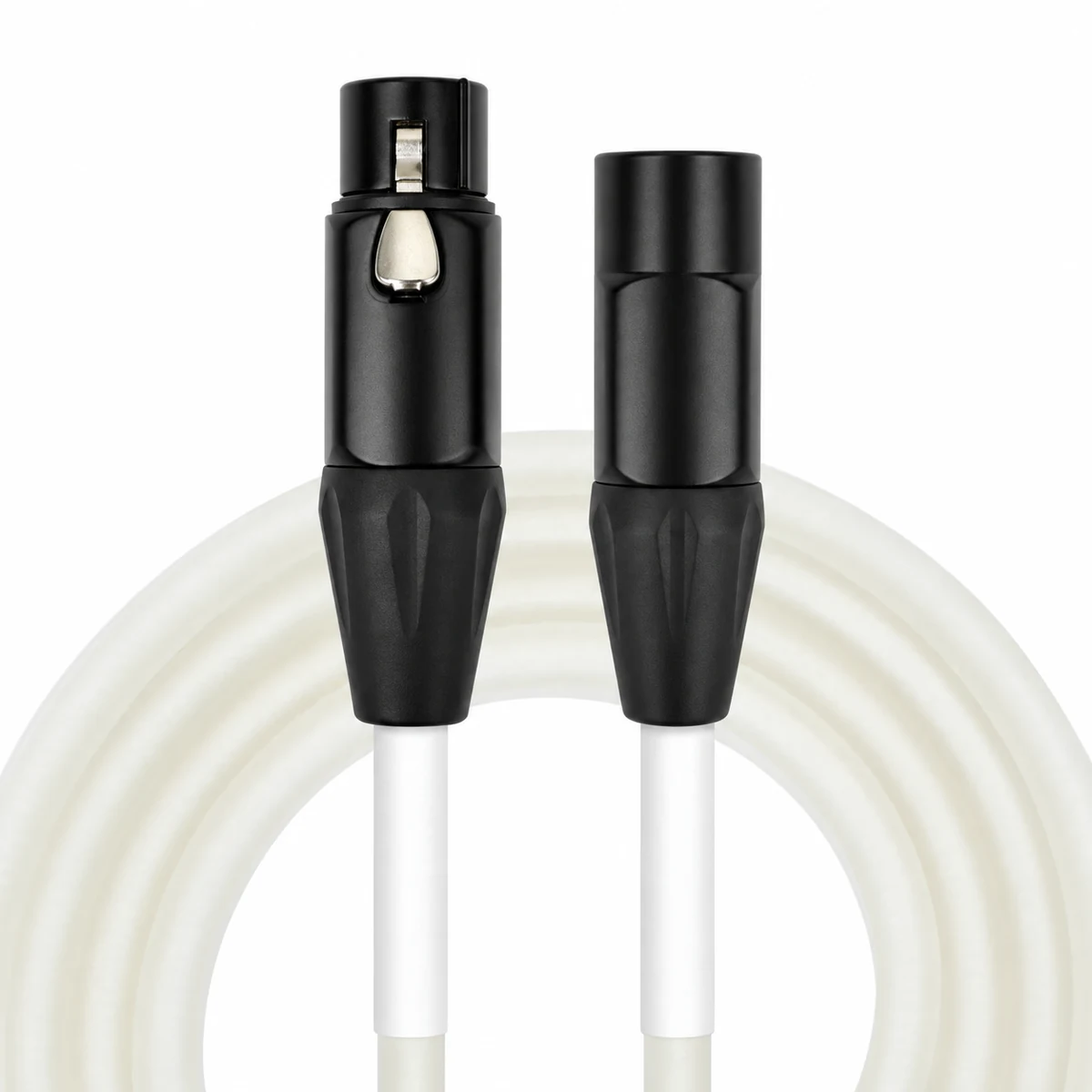
“XLR cable” or “quarter-inch cable” is not a complete product definition. The same connector family can be used in very different systems. A three-pin XLR assembly might carry an analog microphone signal, a balanced line-level signal, or AES3 digital audio. A 6.35 mm plug may be TS or TRS and may serve an instrument, insert, balanced line, or stereo application.
Ask the supplier to explain the signal path and operating environment before recommending a construction. A useful first conversation covers:
- Source and destination equipment
- Signal type and connector gender at each end
- Indoor, installed, studio, mobile, rental, or touring use
- Typical run length and required finished length tolerance
- Frequency of coiling, plugging, transport, and outdoor exposure
- Nearby power, lighting, motors, wireless equipment, or other interference sources
- Required flexibility, abrasion resistance, flame rating, or temperature range
- Target market, packaging format, and compliance documentation
A manufacturer that immediately quotes from a product photo, without clarifying these points, may be treating the assembly as a commodity rather than an engineered item.
2. Confirm that the product category matches the factory’s real capability
Factories often list many cable categories. What matters is the process capability behind the list. A supplier that performs well with molded consumer leads may not have the same experience with serviceable metal XLR connectors, low-capacitance instrument cables, high-current speaker assemblies, or multichannel snakes.
Request evidence that is specific to your intended category:
- Current product drawings or specification sheets
- Photos of relevant assembly and test stations
- Sample inspection records with customer information removed
- Examples of connector termination, strain relief, overmolding, or fanout construction
- Available test fixtures for the exact connector family
- A description of how pinouts and channel identification are controlled
This is especially important for mixed orders. A distributor may want microphone cables, instrument cables, speaker cables, adapters, and branded packaging in one program. Confirm which items are produced on the same site, which are subcontracted, and who owns final inspection.
3. Evaluate engineering support before requesting the lowest price
Good engineering support turns a buying requirement into a controlled specification. The supplier should be able to identify missing information and explain trade-offs without forcing every buyer into one standard construction.
For example, cable diameter affects more than appearance. It must fit the connector’s cable entry and strain-relief range. Conductor size affects resistance, flexibility, weight, and termination space. Shield construction affects coverage, flexibility, termination method, and behavior under repeated movement. Jacket material and thickness affect handling and durability. Capacitance matters particularly in high-impedance instrument connections, where cable construction and length can influence high-frequency response.
Ask the manufacturer to provide a controlled drawing or specification that includes, where applicable:
- Cable type and intended signal
- Conductor material, size, strand construction, and number of cores
- Insulation and jacket materials
- Shield type and stated coverage
- Nominal outer diameter
- Capacitance, characteristic impedance, or conductor resistance when relevant
- Connector manufacturer or approved equivalent
- Pinout and soldering or termination method
- Finished length and tolerance
- Marking, label, color, packaging, and barcode requirements
- Test plan and acceptance criteria
If the supplier cannot produce a clear specification before sampling, it will be difficult to control revisions during mass production.
4. Control materials, shielding, and connector fit
Two cables can look identical while using different conductors, shields, jackets, or connector materials. Avoid undefined terms such as “premium copper” or “professional grade.” Put measurable requirements—conductor material and size, shield type and coverage, jacket, connector model or equivalent criteria—in the approved specification. Require written approval before a controlled item changes.
Treat shielding as a design choice. Braid, spiral/served, and foil constructions differ in flexibility, mechanical behavior, termination, and shielding performance. Match the choice to touring movement, fixed installation, or digital/control requirements, and inspect how the shield is terminated and protected from stray strands.
The connector must also fit the cable. Review the published cable-entry range, retention system, contact data, latch, boot, and strain relief. During sample approval, check gender, pin count, smooth mating, shell security, contact alignment, and the absence of sharp edges or exposed conductors. If alternatives are allowed, define measurable equivalence; appearance alone is insufficient.
7. Examine workmanship standards and operator control
IPC/WHMA-A-620 is a widely recognized industry standard covering requirements and acceptance for cable and wire harness assemblies, including soldered and mechanically secured interconnections, shielding, protective coverings, marking, and finished assembly. Not every commercial audio cable order needs formal IPC certification, but the standard provides a useful reference point for asking how workmanship is defined.
Ask the supplier:
- Are soldering and termination work instructions documented?
- How are operators trained and qualified?
- How are solder temperature, dwell time, strip length, and conductor preparation controlled?
- How are loose strands, cold joints, excessive solder, insulation damage, and shield termination defects identified?
- Is the first completed assembly checked before the production run continues?
- How are rework and repaired units recorded?
The goal is not to collect certificates for a file. It is to understand whether the factory has a repeatable method for preventing hidden assembly defects.
8. Define the test plan before sample approval
Testing should be linked to failure modes. A common finished-audio-cable plan may include:
Electrical checks
- Point-to-point continuity
- Short-circuit and miswire detection
- Pinout or channel mapping verification
- Shield continuity where required
- Contact or loop resistance against an approved limit when specified
- Capacitance, impedance, or insulation tests when relevant to the design
Visual and dimensional checks
- Correct connectors, color, marking, label, and packaging
- Finished length and fanout length
- Cable and boot fit
- Soldering and strain-relief workmanship
- Cosmetic limits for shells, jackets, printing, and packaging
Mechanical or qualification checks
- Cable retention or pull test
- Bend or flex test around the connector exit
- Repeated mating or functional cycling for a new design
- Coiling, handling, or abrasion evaluation for touring products
Not every test belongs on every unit. Continuity and short-circuit tests are practical candidates for 100% finished-assembly testing. Destructive pull tests and extended flex tests are usually better defined as design qualification, first-article, periodic, or sampled checks. Agree on the frequency and pass/fail limits in writing.
9. Use samples to approve a specification, not just an appearance
A sample is useful only when it represents a controlled revision. Before approval, compare it with the drawing and test plan. Record the sample code, revision, date, material choices, length, color, connector version, printing, and packaging.
Perform the same actions the end user will perform:
- Mate it with the intended equipment or reference connectors
- Coil and uncoil it using the expected handling method
- Listen or measure it in the intended signal path
- Check handling noise and flexibility where relevant
- Confirm that labels remain readable and do not interfere with strain relief
- Pack and unpack it as a warehouse or retailer would
Keep an approved “golden sample” or a documented equivalent. A photograph is helpful, but it cannot capture conductor construction, wiring, resistance, or the feel of the jacket.
10. Check batch traceability and change control
When a field issue appears, the buyer must be able to identify what changed and which units may be affected. Ask how the factory links raw materials, connectors, production dates, operators or lines, test results, and packing records to the finished shipment.
The traceability method can be simple, but it should be usable. Batch codes, carton labels, inspection reports, and production records should point to the same order or lot. For recurring programs, require a revision history so that a successful repeat order does not silently revert to an earlier material or label.
11. Evaluate capacity, lead time, and MOQ with evidence
“Large capacity” is not a production plan. Ask for the timing of specification review, sampling, material procurement, mass production, inspection, packing, and booking. Confirm which materials are stocked, what is made to order, and how peak seasons affect the schedule.
MOQ also depends on customization. A standard cable with a custom label may have a different minimum from a special extrusion color, molded connector, printed jacket, or retail box. Request minimums per model, length, color, and package, plus the total order requirement. When launch demand is uncertain, standard construction with controlled branding may reduce risk.
13. Compare total landed risk, not only unit price
A meaningful quotation comparison normalizes the same specification and commercial terms. Review:
- Product unit price and included test scope
- Tooling, printing plate, sample, and packaging charges
- Carton quantity, dimensions, and gross weight
- Incoterm and included export services
- Payment terms
- Spare units or agreed allowance
- Inspection cost and re-inspection responsibility
- Warranty or defect resolution process
- Freight impact of cable weight and retail packaging volume
A cheaper quotation may exclude a connector grade, shielding level, test step, individual packaging, barcode, or documentation included elsewhere. Build a comparison table with exceptions clearly marked.
14. Verify OEM and private-label execution
Private label involves more than adding a logo. A launch-ready program may require color matching, jacket printing, connector marking, labels, barcodes, manuals, warning text, retail packaging, master-carton marks, and product photography.
Ask who checks artwork dimensions, barcode data, spelling, color references, country-of-origin marking, and carton labels. Require digital artwork approval and a physical packaging sample when the risk justifies it. Confirm ownership and storage of printing plates, molds, tooling, and editable artwork.
15. Review communication and corrective-action behavior
The most useful supplier communication is specific. The team should identify gaps, confirm revisions, and document deviations before production. Test this during the sample stage. Send a structured RFQ and observe whether the response answers each requirement or only provides a price.
Also ask how nonconformities are handled. A credible process includes containment, root-cause analysis, corrective action, verification, and a clear disposition for affected goods. Avoid agreements that define every problem as a “small tolerance” after the shipment is complete.
A practical supplier scorecard
Use a weighted scorecard after you have collected comparable evidence.
| Area | Suggested weight | Evidence to review |
|---|---|---|
| Application and engineering support | 15% | Questions asked, drawing quality, trade-off explanations |
| Material and specification control | 15% | BOM, approved alternatives, change-control process |
| Manufacturing and workmanship | 15% | Work instructions, training, first-piece control |
| Testing and inspection | 20% | Fixtures, test plan, reports, acceptance criteria |
| Sample accuracy | 10% | Match to drawing, function, handling, packaging |
| Capacity and delivery | 10% | Stage plan, material availability, production evidence |
| Traceability and corrective action | 10% | Lot records, revision history, problem-solving process |
| Commercial fit | 5% | MOQ, total cost, payment and warranty terms |
Adjust the weights to your market. A touring rental supplier may give more weight to mechanical durability and serviceability. A private-label retailer may add packaging control. A fixed-installation buyer may emphasize documented fire or regulatory requirements.
Red flags during supplier evaluation
- Quoting without confirming the application or pinout
- Refusing to provide a controlled specification
- Treating shield coverage or copper terminology as a slogan rather than a measurable requirement
- Using “same quality” to justify unapproved connector or material substitutions
- Providing a sample that cannot be linked to production materials
- Offering test reports without model, lot, date, method, or acceptance limits
- Promising any MOQ or lead time before reviewing customization
- Avoiding discussion of failed tests, rework, or corrective action
- Changing packaging, colors, or printing after approval without written notice
RFQ information to send a shortlisted manufacturer
Provide enough detail for a comparable quotation:
- Product category and application
- Connector A and connector B, including gender and pin count
- Wiring diagram or required pinout
- Cable construction and key electrical requirements
- Finished lengths and tolerances
- Jacket color, printing, labels, and identification
- Packaging and barcode requirements
- Target order quantity by model and forecast volume
- Destination market and required documentation
- Sample, testing, inspection, and delivery expectations
If information is unknown, mark it as open for engineering recommendation. Do not allow an unknown requirement to become an undocumented assumption.
Frequently asked questions
What is the most important test for a finished audio cable assembly?
There is no single test that covers every failure mode. Point-to-point continuity, short-circuit detection, and pinout verification are core electrical checks for finished assemblies. Visual workmanship, strain relief, dimensions, labeling, and application-specific tests are also needed. The approved test plan should match the design and use case.
Should every cable be electrically tested?
For finished cable assemblies, 100% continuity and short-circuit testing is practical and commonly requested. Other tests—such as destructive pull, extended flex, detailed resistance measurement, or environmental conditioning—may be performed on first articles, samples, or periodic lots. State the frequency in the purchase specification.
Is a factory certificate enough to qualify a supplier?
No. A certificate may support the evaluation, but it does not prove that your product specification, materials, workmanship, and test plan are controlled. Review product-specific evidence and verify the production sample.
How can buyers reduce quality variation on repeat orders?
Freeze the approved specification and BOM, identify the revision on purchase orders, retain a golden sample, require written change approval, use batch traceability, and compare inspection results across lots. Repeat orders should reference the same controlled documents as the first order.
Conclusion
The right professional audio cable manufacturer is the one that can repeatedly deliver your approved requirement—not merely produce an attractive sample or a low quotation. Start with the application, convert it into a controlled specification, verify the supplier’s category experience, approve a traceable sample, and agree on testing and change control before mass production.
This approach makes quotations easier to compare and reduces avoidable problems during shipment inspection, product launch, and repeat ordering.
Send your requirements to ToneBraid
Planning a distributor range, private-label program, or custom cable assembly? Send ToneBraid your application, connector types, lengths, quantity, branding, packaging, and target market. Our team can review the information and identify the open technical items needed for a useful quotation.